Australian Economy Grows 2.3%, but Household Gains Remain Modest

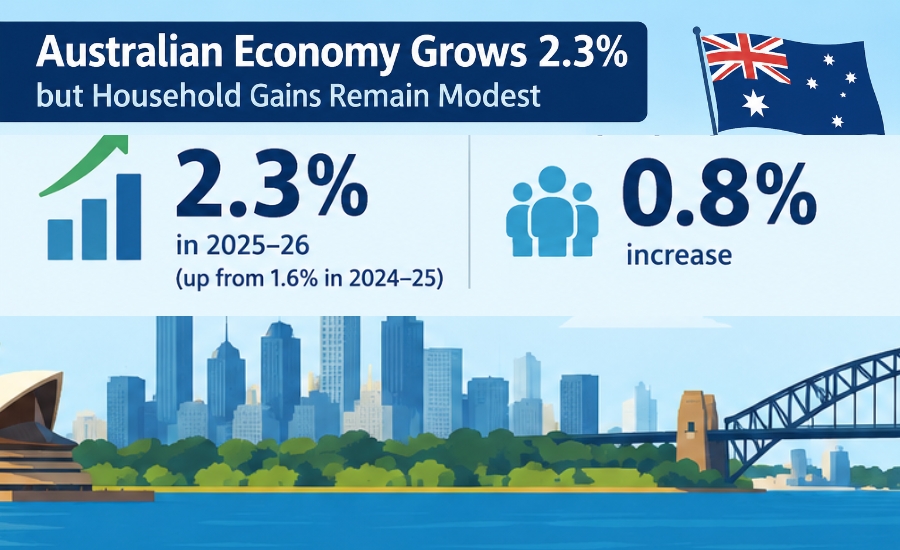
Australia’s economy grew by 2.3 per cent in the 2025–26 financial year, up from 1.6 per cent the previous year. However, economic output per person increased by only 0.8 per cent, highlighting the impact of population growth. Figures released by the Australian Bureau of Statistics (ABS) show that the economy expanded overall, but the benefits of that growth were more limited when measured on a per-person basis.
Households Save More
The household saving ratio increased to 6.1 per cent, compared with 5.5 per cent in the previous financial year. This means households kept a larger share of their income instead of spending it. The increase may reflect greater caution about future expenses and financial security.
Real net national disposable income, which measures the income available to the country after accounting for inflation and international income flows, rose by 2.2 per cent. Australia’s national net worth also increased by $1.3 trillion, reaching $22.8 trillion.
Growth Across Economic Sectors
The market sector, which includes businesses selling goods and services, recorded growth of 2.5 per cent. The non-market sector, including public services such as healthcare, education and public administration, grew by 2.0 per cent. These figures indicate that both business activity and public services contributed to economic expansion.
Inflation and Unemployment Remain Important
Despite the annual economic growth, households continued to face cost-of-living pressures. The Consumer Price Index rose by 4.0 per cent in the year to August 2026, while the unemployment rate reached 4.7 per cent in September. The figures suggest that although Australia’s economy expanded during the year, growth in output per person remained modest amid rising prices and ongoing pressure on household budgets.
Understanding the Figures
The ABS publishes annual national accounts that update earlier economic estimates using more complete information. The reported 2.3 per cent growth rate measures changes in economic output after adjusting for price movements, providing a clearer picture of changes in the volume of goods and services produced.
Sources
- Australian Bureau of Statistics, Australian System of National Accounts, 2025-26 financial year, released 23 October 2026
- Australian Bureau of Statistics, Consumer Price Index, Australia, August 2026
- Australian Bureau of Statistics, Labour Force, Australia, September 2026
- Australian Bureau of Statistics, National accounts
Most read
 Card Payment Surcharges to End Across Australia from 1 October
 Nearly 2 million Quest customers affected by data breach
 NDIS watchdog closes only one in three complaints on time as backlog nears 13,000
 NT mango growers warn working holiday visa changes could worsen seasonal worker shortages
 Crime falls in Victoria as auditor-general finds no evidence $40m youth program works