Almost half of Victoria’s state roads rated poor or very poor
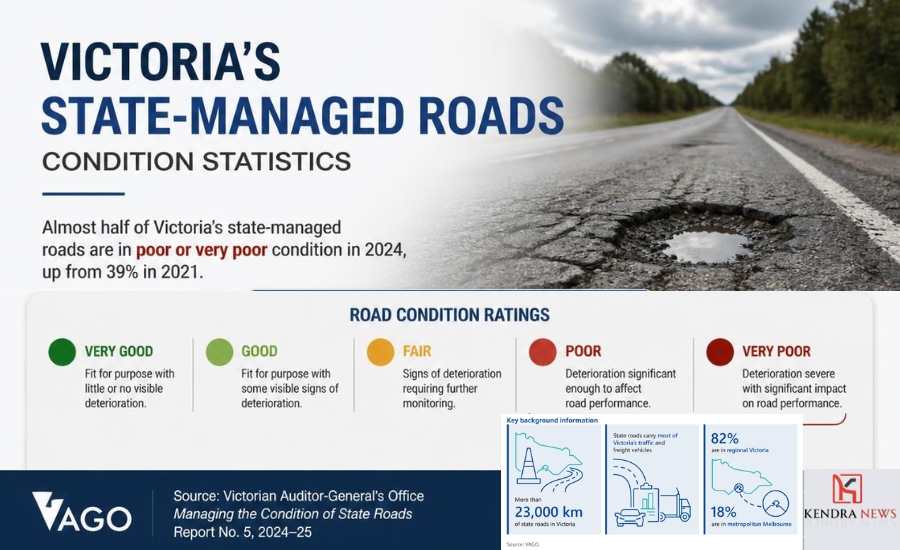
Almost half of Victoria’s state-managed roads were in poor or very poor condition in 2024, up from 39 per cent in 2021, according to a report by the Victorian Auditor-General’s Office (VAGO).
The report, tabled on 9 September, found that about 48 per cent of the state road network was rated poor or very poor in 2024. It said Victoria had a large and growing road maintenance backlog, with deterioration occurring faster than maintenance and repairs were addressing the network’s needs.
In 30 Victorian local government areas, at least half of the state-managed roads were rated poor or very poor.
VAGO’s accompanying data also shows a concentration of unresolved pothole reports across parts of regional Victoria and Melbourne’s outer suburbs. In metropolitan Melbourne, the Mornington Peninsula recorded the highest number of unresolved pothole reports, followed by outer-suburban areas including Melton and Hume. In regional Victoria, Towong and Moyne were among the areas with the highest numbers.
State-managed roads account for about 15 per cent of Victoria’s road network by length but carry most of the state’s traffic and freight. About 82 per cent of the state-managed network is in regional Victoria, according to VAGO.
The Victorian Government has committed an additional $352 million to road maintenance and has increased its pothole-repair target from 250,000 to 500,000 during the 2026–27 financial year.
Premier Ben Carroll has said most of the 500,000 potholes are expected to be repaired by the end of January, with work expected to accelerate as rainfall eases and conditions become drier.
If all 500,000 repairs were completed between 1 July 2026 and 31 January 2027, the target would equate to an average of about 2,326 repairs a day. From 15 September, achieving the same total by 31 January would require an average of about 3,600 repairs a day. These figures are a calculation based on the announced target and timeframe, rather than a government-reported daily requirement.
The additional funding comes on top of the $1.04 billion allocated to road asset management in the 2026–27 state Budget, bringing total road asset-management funding to about $1.39 billion for the financial year.
VAGO raised concerns about how the Department of Transport and Planning manages road-maintenance data and sets priorities. The audit found that key maintenance information was stored across multiple incompatible systems, while some datasets were of poor quality. As a result, the department could not easily access an integrated view of relevant information or demonstrate that it was using available data to prioritise works and optimise funding.
The audit also found that the department did not always clearly document why particular sites were prioritised for maintenance or why decisions departed from modelled maintenance programs. VAGO said this reduced transparency around how maintenance decisions were made.
The auditor-general recommended that the government improve public reporting on road conditions and publicly report the road maintenance backlog. The Department of Transport and Planning accepted the recommendations in full or in principle.
The findings come ahead of Victoria’s state election on 28 November, with road maintenance expected to be an issue during the campaign. The Opposition was contacted for comment.
As of 21 September, the Victorian Government had not publicly released a current breakdown showing how many of the 500,000 potholes had been repaired during the 2026–27 financial year.
Source: VIC GOV