Thriving Kids rollout begins in six Victorian areas, four of them in Melbourne’s north and west

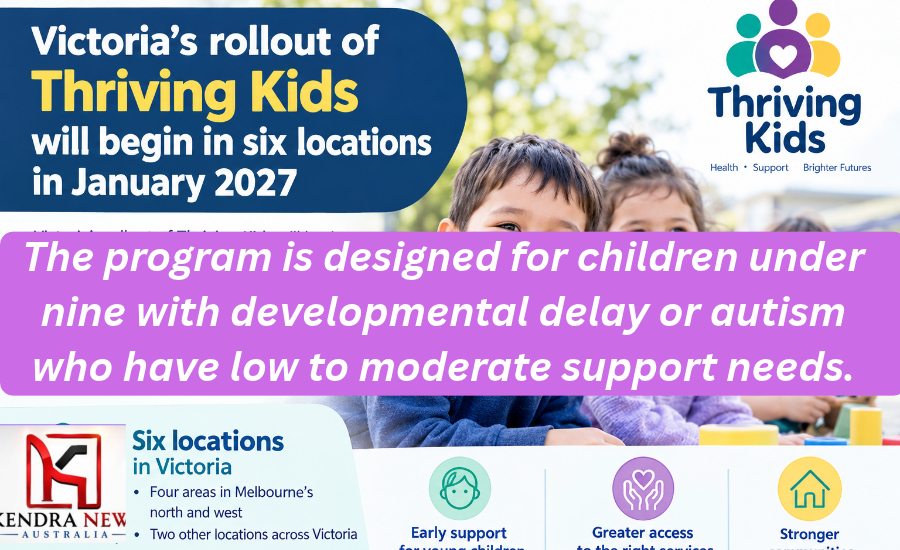
Victoria’s rollout of Thriving Kids will begin in six locations in January 2027, including four areas in Melbourne’s north and west, under a program the federal government is introducing as an alternative to the National Disability Insurance Scheme for some young children.
The program is designed for children under nine with developmental delay or autism who have low to moderate support needs. Key details, including how eligibility will be assessed, are still being developed. For families currently using or considering the NDIS, one point is clear. There will be no change to how children with developmental delay or autism access the NDIS until 1 January 2028, and children can continue to apply under the existing arrangements until then.
What Thriving Kids Victoria will provide
Victoria’s six initial delivery sites are Bendigo, Hobsons Bay, Hume, Loddon, Maribyrnong and Melton. Four of them, Hume, Hobsons Bay, Maribyrnong and Melton, are in Melbourne’s north and west, areas with established migrant communities. From January 2027, those sites will offer targeted allied health and support services to help children build everyday skills and independence, and to help families support their child’s development. The support is time-limited.
The sites will also introduce two new developmental checks, one when a child starts kindergarten and one when they start school, carried out by allied health professionals and trained clinicians.
Services are due to expand to all areas of Victoria throughout 2027, with the full range of Thriving Kids services to be delivered across the state from 2028. Victoria’s Department of Education will lead the targeted supports, developmental checks, triage and intake. The state government has said community partner organisations may deliver targeted allied health where that best meets community needs.
Supports that began in October include practical information and guidance, expanded access to the Advocating for Children with Disability Support Line, more publicly funded autism assessments, more places in the Strengthening Parent Support program, and additional training for early years educators on inclusion and on identifying developmental concerns earlier. Minister for Children Lizzie Blandthorn announced the Victorian supports on 30 September.
“These initial supports will lay the foundation for the full complement of Thriving Kids services,” Ms Blandthorn said.
Nationally, the program began on 1 October with general information and guidance through the Thriving Kids Autism Helpline, operated by the autism organisation Amaze on 1300 654 789, and an online resource hub run by the Raising Children Network. From 1 November, three-year-old children will be able to access a Medicare-funded developmental health check intended to identify developmental concerns earlier.
Thriving Kids has a national funding commitment of $4 billion. The NDIS cost more than $50 billion in the previous financial year.
NDIS access remains unchanged until 2028
Although Thriving Kids is described as an alternative for some children currently supported by the NDIS, its launch does not mean families need to leave the existing scheme.
NDIS access arrangements remain unchanged until January 2028, when Thriving Kids is expected to be fully implemented and new eligibility criteria are due to take effect. Children with permanent and significant disability, including developmental delay and autism, will remain eligible for the NDIS beyond 2028. Families will not need a formal diagnosis or a specialist referral to access Thriving Kids supports. Minister for Health, Disability and Ageing Mark Butler said the two systems would operate alongside each other during the transition.
“We’ll have two systems operate in parallel,” Mr Butler said.
“We’re not going to let parents and children fall between two stalls.”
The precise meaning of low to moderate support needs has not been defined, and the assessment process that will determine which children receive support through Thriving Kids and which remain eligible for the NDIS is still being designed. Skye Kakoschke-Moore, chief executive of Children and Young People with Disability Australia, said it was “unclear exactly what that means”, referring to the threshold.
Advocates have also raised concerns about children with moderate support needs, children who may no longer qualify for the NDIS but are too old for Thriving Kids, and the capacity of education settings to provide additional support. Mr Butler has said discussions are continuing with state and territory governments about support for children older than nine.
Questions for multilingual families
Concerns have been raised about whether Thriving Kids will adequately support Indigenous children and children from culturally and linguistically diverse backgrounds. The Victorian government’s announcement of the six initial sites does not mention translated information, interpreter services or partnerships with multicultural community organisations. Its only reference to delivery partners is a general mention of community partner organisations that may deliver targeted allied health where that best meets community needs. The concentration of four initial sites in Melbourne’s north and west makes the question relevant to local families. The government has not said the locations were selected to serve migrant communities.
How other states are preparing
The rollout differs between jurisdictions. Western Australia has allocated $361 million over five years for Thriving Kids services, and has outlined a role for Aboriginal community-controlled organisations in developing them. New South Wales has supported playgroups and parenting programs available now, with allied health services due in 2027.
South Australia is expanding preschool and child development checks, with targeted supports to be commissioned in the first half of 2027. Tasmania is starting with playgroups and Early Childhood Connectors, with the full range of supports from 1 January 2028. The Australian Capital Territory has opened an information and navigation line on 02 6205 5500, with targeted supports rolling out over the next 15 months. In the Northern Territory, existing services continue while Thriving Kids is introduced through NT Health allied health teams. Queensland has not formally signed up to the national program.
Across the country, the full rollout is expected by January 2028. Families can contact the Thriving Kids Autism Helpline on 1300 654 789 for autism-related information and guidance. Eligibility criteria and the assessment process are still being developed.
Source:
- Premier of Victoria, “More Help For Children With Developmental Delay And Autism”, 30 September 2026
- “What is and isn’t changing today as NDIS alternative Thriving Kids begins”, ABC News, 1 October 2026
- “Queensland lashed over Thriving Kids holdout, days out from launch”, ABC News, 23 September 2026
- Mark Butler, Minister for Health, Disability and Ageing
- NDIS, Thriving Kids
- NSW Department of Communities and Justice, Thriving Kids
- Skye Kakoschke-Moore, Children and Young People with Disability Australia
- Amaze, Thriving Kids Autism Helpline: 1300 654 789
Most read
 Card Payment Surcharges to End Across Australia from 1 October
 Nearly 2 million Quest customers affected by data breach
 NSW Expands Paid Internship Program Across Creative Industries
 Goodwin Aged Care Services to repay $1.39 million after employee underpayments
 NDIS watchdog closes only one in three complaints on time as backlog nears 13,000