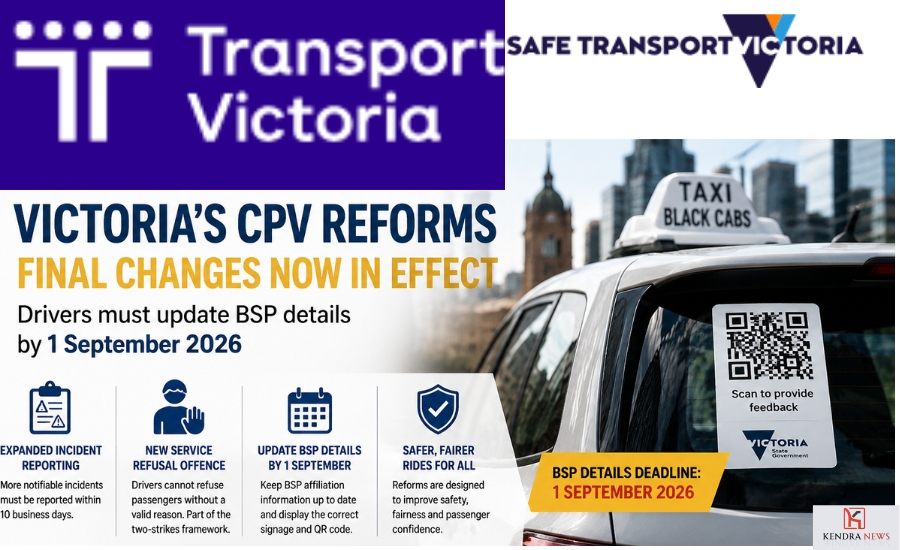
Victoria’s CPV Reforms: Drivers Must Update BSP Details by 1 September 2026
MELBOURNE — Victoria’s major reform program for the commercial passenger vehicle (CPV) industry has entered its final stage, with the remaining changes taking effect from 1 August 2026.
The reforms, introduced progressively throughout 2026, are aimed at strengthening passenger safety, improving fare transparency, increasing accountability and creating clearer responsibilities for drivers, vehicle owners and Booking Service Providers (BSPs).
Safe Transport Victoria (ST Vic) says the final changes include expanded notifiable incident reporting and a new service refusal offence for unbooked CPV services.
New reporting and service obligations to Drivers
From 1 August, a wider range of incidents involving CPV services must be reported to ST Vic.
For both booked and unbooked services, reportable incidents now include:
-
charging a card or electronic payment surcharge above the permitted amount;
-
refusing to carry a passenger with an assistance animal; and
-
complaints alleging sexual assault, sexual harassment, indecent exposure, assault, physical threats or other intimidation.
For unbooked services, including rank-and-hail services, additional incidents must be reported when a driver:
-
charges or asks for more than the maximum permitted fare; or
-
refuses to provide a CPV service without a valid exception.
These reporting obligations apply to CPV duty holders, including drivers, BSPs and vehicle owners. Notifiable incidents must generally be reported within 10 business days using ST Vic’s updated online reporting process.
New service refusal offence
A major change from 1 August is the introduction of a new service refusal offence for drivers providing unbooked CPV services.
Drivers who are available to provide an unbooked service, including rank-and-hail services, must accept a passenger unless a valid exception applies.
Exceptions can include genuine safety concerns, abusive or violent passenger behaviour, insufficient seatbelts, concerns about payment and other circumstances permitted under the regulations.
The new offence forms part of Victoria’s “two-strikes” framework. Under the framework, repeated serious offending can result in the cancellation of a driver’s accreditation when the legal requirements are met.
Deadline for BSP affiliation details from 1st september
ST Vic has also reminded all CPV drivers that they must update their Booking Service Provider (BSP) affiliation details by 1 September 2026.
Drivers must keep these details current when applying or renewing accreditation and whenever their circumstances change.
From 1 July, drivers have also been required to ensure that any BSP signage, branding or other BSP-related material displayed on their vehicle relates only to a BSP with which they are actually affiliated. CPV vehicles must also display the required ST Vic QR code while providing services, unless an approved digital complaints pathway applies.
The QR code allows passengers to provide feedback or make complaints directly to ST Vic.
New responsibilities for Booking Service Providers
BSPs also have additional responsibilities under the reforms.
They must take reasonable steps to ensure affiliated drivers display the required QR code or an approved electronic alternative where applicable.
BSPs must also comply with the updated camera and audio recording requirements that apply to their services. They are required to register a Designated Person with ST Vic who is approved to access relevant recordings. Registration for designated persons opened on 10 August 2026.
Camera and audio requirements strengthened
Another major stage of the reforms began on 1 July 2026, particularly for unbooked CPVs required to have approved security camera systems.
The updated requirements include:
-
audio recording alongside video;
-
retention of recordings for 14 days, increased from the previous 72-hour period;
-
minimum video quality requirements; and
-
rules governing access to recordings by BSPs for prescribed purposes.
ST Vic’s implementation guidance states that approved security camera systems used in relevant unbooked CPVs must record both audio and video, and passengers must be notified through appropriate signage.
Disciplinary action now published on CPV Public Register
From 1 July 2026, ST Vic also began publishing details of formal disciplinary actions on the CPV Public Register.
The published information can include the driver’s name, the outcome of the disciplinary action and a short description of what occurred.
The changes apply to disciplinary action taken from 1 July 2026 and published after applicable appeal periods have passed. Warnings and education actions are not included.
March reforms introduced QR codes and stronger enforcement
Earlier in the reform rollout, significant changes took effect from 1 March 2026.
All taxis and rideshare vehicles providing CPV services became required to display an official ST Vic QR code. The QR system was introduced to make it easier for passengers to provide feedback and lodge complaints.
The government also introduced stronger consequences for repeat serious meter misuse. Drivers convicted in court twice within 10 years for specified serious meter offences may lose their driver accreditation.
The March reforms also strengthened rules around BSP signage, requiring drivers to display signage only for the BSP with which they are actively operating.
The reforms also strengthened the Public Care Objective, clarifying regulatory action in relation to serious inappropriate conduct, including sexual harassment, sexual assault and assault.
January: Higher penalties for meter offences
The reform program began the 2026 calendar year with increased penalties for two existing meter-related offences involving unbooked taxi and rideshare services.
From 1 January 2026, drivers were subject to higher penalties for failing to use a working fare calculation device throughout an unbooked trip or failing to stop the meter when the trip ended.
The infringement penalty increased from 2.5 to 4 penalty units, rising from $508.77 to $814.04. The maximum penalty that a court can impose increased from 10 to 20 penalty units.
ST Vic said the changes were intended to support fair pricing, improve passenger confidence and address concerns about overcharging in unbooked services.
A reform package introduced progressively
The 2026 changes form part of the Victorian Government’s broader CPV Reform Package announced in April 2025. Rather than introducing all requirements at once, the reforms have been implemented in stages covering fares, driver conduct, passenger protections, QR codes, BSP affiliation, camera and audio recording, disciplinary transparency and incident reporting.
CPV reform timeline
January 1, 2026:
Higher penalties for two meter offences came into effect.
March 1, 2026:
Mandatory ST Vic QR codes, stronger consequences for repeat serious meter misuse and clearer BSP signage requirements took effect.
July 1, 2026:
New BSP affiliation requirements, public register changes and updated camera and audio requirements for relevant unbooked CPVs commenced.
August 1, 2026:
The final stage began, introducing expanded notifiable incident reporting and the new service refusal offence for unbooked CPV services.
September 1, 2026:
CPV drivers must have their BSP affiliation details updated and must continue keeping those details accurate.
What CPV drivers need to do now
With the final reforms now in effect, drivers should:
-
Update BSP affiliation details by 1 September 2026.
-
Keep BSP information accurate whenever circumstances change.
-
Display BSP signage only for providers with which they are affiliated.
-
Ensure the required ST Vic QR code is displayed, unless an approved digital pathway applies.
-
Understand the new service refusal rules for unbooked services.
-
Report relevant notifiable incidents within the required timeframe.
-
Check that applicable camera and audio systems meet the updated standards.
-
Continue complying with meter and fare requirements.
ST Vic says the reforms are intended to make the Victorian CPV industry safer, fairer and more accountable while improving protections and confidence for passengers.
Sources:SafeTransport
Final Reforms To Take Effect 1 August | Safe Transport Victoria
Penalty Increases For Meter Offences Start 1 January | Safe Transport Victoria
Victorian Government CPV Reforms: What Drivers Need To Know | Safe Transport Victoria
Next Phase Of CPV Reforms Begins On 1 July | Safe Transport Victoria
Making rides safer for everyone – Transport Victoria