Why Are EPA, EPG and a Will Essential for People Living in Australia?
Umesh Dhakal
KNA- Canberra
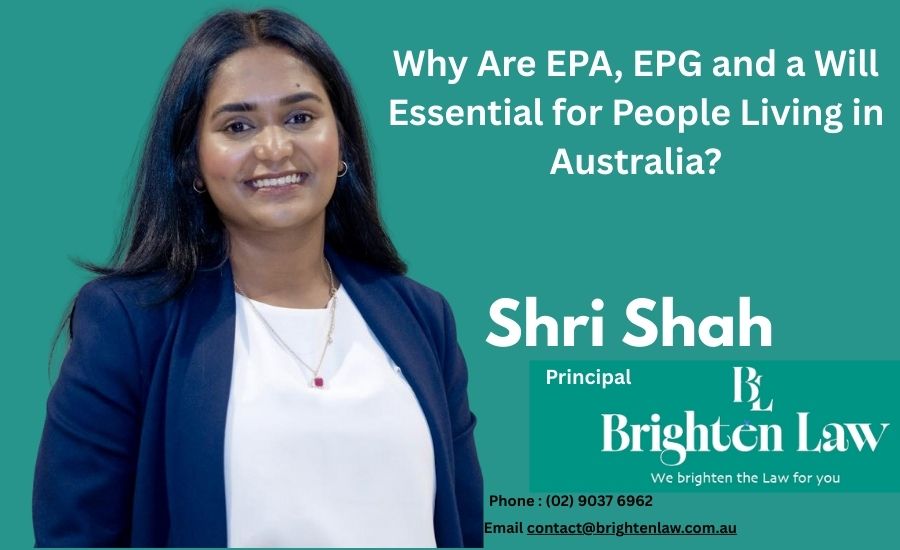
A short legal awareness report prepared with special input from Licensed Australian Lawyer – Shrishti Shah (Shri)
Legal planning is an essential but often overlooked responsibility for Nepalese and other migrant communities permanently living in Australia. Many people delay or ignore important documents such as an Enduring Power of Attorney (EPA/EPOA), Enduring Power of Guardianship (EPG/EG), and a Will, not realising the serious legal and practical consequences.
In Australia, these three documents are considered fundamental legal safeguards. They protect an individual’s health decisions, financial management, personal care, asset security, and post-death arrangements. Proper legal planning ensures peace of mind for individuals and reduces stress, conflict, and legal complications for families in the future.
To explain these matters in a simple and practical way, we spoke with Licensed Australian Lawyer Shrishti Shah.
Q1: Why are EPA/EPOA, EPG/EG and a Will considered essential in Australia?
These documents form the foundation of future protection. If a person becomes unable to make decisions due to an accident, serious illness, stroke, or loss of mental capacity, only the person legally appointed through these documents has authority to act on their behalf.
Without these documents, even close family members may not be able to make decisions with banks, hospitals, or government agencies. In such cases, families often need to apply to a tribunal, which can be time-consuming, stressful, and costly.
What is a Tribunal?
A tribunal is a legally authorised body that is less formal than a court but has decision-making powers over matters such as financial management, guardianship, health, and personal care.
- NSW: NSW Civil and Administrative Tribunal (NCAT)
- ACT (Canberra): ACT Civil and Administrative Tribunal (ACAT)
Q2: What is an Enduring Power of Attorney (EPA/EPOA)?
An Enduring Power of Attorney allows you to appoint a trusted person (Attorney) to make financial and legal decisions on your behalf if you lose decision-making capacity.
An appointed Attorney may:
- Operate bank accounts
- Pay bills, loans, and mortgages
- Buy or sell property
- Manage investments
- Deal with taxation and superannuation administration
These powers are regulated by state law and can begin immediately or only when capacity is lost, depending on how the document is drafted.
Q3: Why is an Enduring Power of Guardianship (EPG/EG) important?
An Enduring Power of Guardianship applies to health, personal care, and lifestyle decisions, such as:
- Choice of hospital, medical treatment, or aged care facility
- Consent to or refusal of medical and dental treatment (within legal limits)
- Living arrangements and care services
- Religious, cultural, and lifestyle preferences
By appointing a guardian in advance, you ensure that decisions are made according to your values and wishes, rather than being decided by institutions or tribunals.
A guardian cannot:
- Make financial decisions
- Create or change a Will
- Vote or marry on your behalf
- Consent to certain special medical procedures without tribunal approval
Q4: Why is a Will so important?
A Will is a legal document that states how your assets will be distributed after your death.
If there is no Will, your estate is distributed according to intestacy laws, which may not reflect your wishes.
A Will can:
- Specify who receives your property and assets
- Appoint an Executor to manage your estate
- Nominate guardians for minor children
- Provide guidance for funeral arrangements (not legally binding, but usually followed)
Having a Will significantly reduces the risk of family disputes and legal uncertainty.
How These Documents Work in Different States
1. New South Wales (NSW)
Key documents used in NSW:
- Enduring Power of Attorney (EPA) – financial and legal decisions
- Enduring Guardian (EG) – health and lifestyle decisions
- Will – estate distribution after death
Important points:
- EPA must be witnessed according to the Powers of Attorney Act 2003 (NSW)
- Attorneys must formally accept their appointment
- EPA must be registered with NSW Land Registry Services if property transactions are involved
- EG operates under the Guardianship Act 1987 (NSW)
- A Will must be signed in the presence of two independent witnesses
2. Australian Capital Territory (ACT – Canberra)
Key documents used in ACT:
- Enduring Power of Attorney (EPOA)
- Will
In ACT, an EPOA can cover:
- Financial matters
- Personal care
- Health care decisions
Important limitations:
- An Attorney cannot make or change a Will
- Cannot vote or make certain highly personal decisions
- Cannot usually change binding superannuation death benefit nominations unless legally authorised
Legal requirements:
- Approved ACT forms must be used
- Proper witnessing is mandatory
- Attorneys must formally accept their appointment
- Powers must be clearly defined (financial, personal care, health)
If no valid documents exist, applications may need to be made to ACAT, creating delays and added costs.
How Can These Documents Be Prepared?
These documents can be prepared through:
- A licensed Australian lawyer or solicitor
- Public Trustee and Guardian
- Community Legal Centres
General steps include:
- Choosing trusted Attorneys and/or Guardians
- Providing identification and personal, financial, and asset details
- Preparing documents using approved legal forms
- Signing documents with qualified witnesses
- Safely storing original documents and sharing certified copies where needed
Final Note
For anyone living in Australia—especially those with property, savings, or family responsibilities—having the correct legal documents in place is not optional, but essential. These documents protect not only your rights, but also your family from unnecessary legal hardship.
This article provides general information only. Because laws vary by state and individual circumstances differ, professional legal advice is strongly recommended.
For further legal assistance, you may contact:
Licensed Lawyer Shrishti Shah
Brighten Law, Sydney
📞 Phone: (02) 9037 6962
📧 Email: contact@brightenlaw.com.au
“If you are interested in the Nepali version, please go to this link.” ✅
अष्ट्रेलियामा बस्नेका लागि EPA, EPG र Will कागजात किन अनिवार्य छन्?