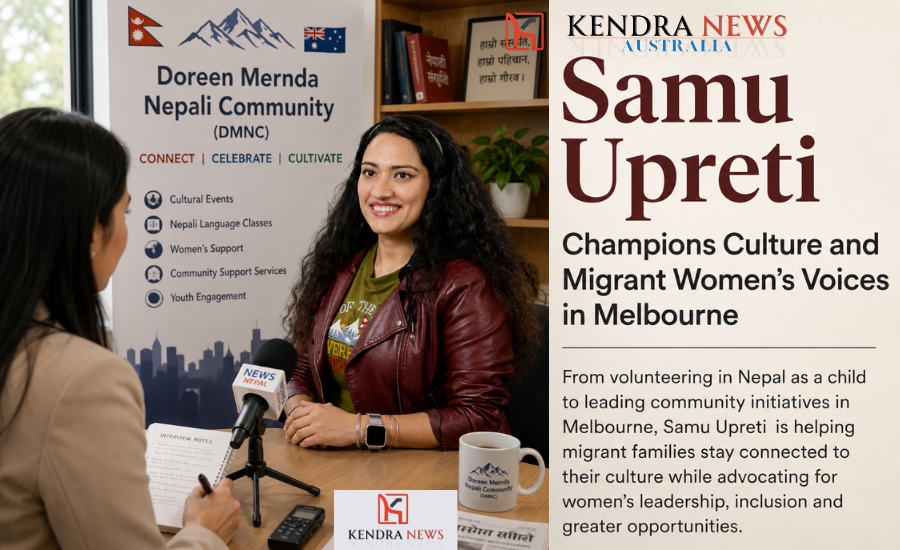
Samu Upreti Champions Culture, Community and Migrant Women’s Voices in Melbourne
Melbourne, Australia — For many people, weekends are a chance to rest, spend time with family, or catch up on personal commitments. For Samu Upreti, however, weekends are often dedicated to another kind of responsibility: serving the community. Whether she is organising cultural events, preparing grant applications, sharing community information, coordinating volunteers, or helping run Nepali language classes, much of her free time is devoted to supporting Nepalese families across Melbourne’s growing northern suburbs.
Over the years, community service has become more than a volunteer role. It has become a central part of her life.“Working for the community can be very tiring at times,” Upreti says. “But when you see people connecting, learning, and moving forward, it makes all the hard work worthwhile.”
Currently, Upreti serves as Treasurer of the Doreen Mernda Nepali Community (DMNC), a volunteer position she describes as both demanding and rewarding. While the role comes without financial compensation, she believes it plays an important part in helping migrant families build connections and a sense of belonging in their new country.
“We don’t get paid,” she says. “That’s why not everyone does community work. When you have work, family and other responsibilities, it can be very hard to manage everything.”
From Kathmandu to Melbourne
Upreti arrived in Australia from Kathmandu in 2009, seeking better opportunities and a more secure future. At the time, she says, Nepal’s political and economic circumstances made it difficult for many young people to find stable employment. Like many migrants, she arrived with hopes of building a better life but soon discovered that settling into a new country came with its own challenges.Language barriers, unfamiliar accents, cultural differences and limited employment opportunities made the transition difficult.
“Their English is so fast, it’s hard to understand,” she recalls with a smile. “The accent in Nepal is very different from the Australian accent, so that caused a lot of trouble in the beginning.” Yet community service had already become part of her identity long before she migrated. Growing up in Nepal, Upreti became involved in volunteer work from around the age of ten. Through The Women’s Foundation Nepal, she worked alongside programs supporting women and children affected by domestic and marital violence while also helping promote literacy initiatives for women who had missed educational opportunities. Those experiences left a lasting impression.“I used to think that when I grow older, I will definitely help women and children,” she says. More than a decade later, that commitment continues to shape her work in Australia.
Building a Community from the Ground Up
In 2017, Upreti moved to Doreen, a suburb in Melbourne’s northeast. At the time, only a small number of Nepalese families lived in the Doreen and Mernda areas. Community members would gather informally to celebrate festivals, welcome new arrivals and discuss how to help their children maintain a connection with Nepalese language, culture and traditions while growing up in Australia.What began as a handful of conversations gradually evolved into a structured community organisation. Upreti initially volunteered her time before becoming an executive member in 2019. She currently serves as Treasurer of DMNC for the 2024–2026 term. Her responsibilities extend well beyond financial management.
She helps organise cultural celebrations, supports women’s gatherings, collaborates with other community organisations and assists with the operation of Nepali language classes. According to Upreti, around 150 students are currently enrolled in the classes, including children from neighbouring suburbs such as South Morang. Meanwhile, the Nepalese population in the Doreen and Mernda area has grown significantly. More than 600 Nepalese families now call the area home. Having witnessed the community’s growth from its early stages, Upreti says the progress makes her proud.
For her, DMNC is not simply an organisation that hosts events. “It’s connecting Nepalese people, so they don’t feel alone,” she says.
Creating Belonging in a New Country
One of the realities Upreti has observed within migrant communities is the challenge of balancing life between two worlds: the homeland left behind and the new country being built. She has seen how elderly parents visiting from Nepal can experience loneliness when family members are busy with work and school commitments. Many spend long hours at home while their children are at work and their grandchildren are at school. Community gatherings, language classes and social events provide opportunities to meet other Nepalese families, build friendships and share experiences.
“These activities help people connect,” she says. “They give people somewhere to belong.” The benefits extend beyond older generations. Community events and language classes also help young people understand their cultural heritage and maintain a connection with their roots. Children learn about Nepalese festivals, traditions and customs while also growing up as part of Australian society.
Upreti believes both identities are important. “Children should enjoy Australian celebrations and learn about other cultures,” she says. “But they should also stay connected to their own culture and understand where they come from.”
Advocating for Women’s Leadership
Women’s empowerment has remained a consistent focus throughout Upreti’s life. Her experiences in Nepal and Australia have shown her that women often face additional barriers when participating in leadership, community work and public life. She believes these challenges can become even greater after women become mothers. “Especially after being a mum, being a parent, it’s very hard to manage everything,” she says. Balancing family responsibilities, work, study and community involvement can leave many women with little time or confidence to pursue leadership opportunities. In some cases, women may also hesitate to seek support or speak openly about personal and family challenges. While Upreti believes women today may enjoy greater freedom and opportunities than previous generations, she says significant gaps remain.
For her, women’s empowerment is not simply about encouraging women to become stronger. It also requires families, communities and institutions to create environments where women can participate, learn, lead and pursue their goals.
She believes men must also be part of the conversation.“Men need to understand women’s goals, feelings and the support they need,” she says. “Communities and families need to create opportunities for women to learn, work and participate in public life.”
Taking Community Advocacy into Politics
Years of community involvement eventually inspired Upreti to consider a more formal role in public life. She believes policy decisions can have a direct impact on the resources and opportunities available to migrant families, women and community organisations. In 2025, she contested the Lalor Ward by-election for Whittlesea City Council, receiving 312 first-preference votes. Although she was not elected, she considers the experience an important step in her leadership journey.
“Because I was campaigning in an unfamiliar ward, not many voters knew me,” she says. The campaign strengthened her interest in advocating for multicultural communities, women and children. “I always wanted to be a voice of the people,” she says. “I will try again when the opportunity comes.”
For Upreti, representation means more than simply seeing candidates from diverse backgrounds on election ballots.She believes migrant communities should have genuine access to leadership pathways, funding opportunities, training programs and public participation.
Leaders with migrant experiences, she says, often understand the barriers faced by culturally diverse communities in ways others may not. “Every migrant deserves the same opportunities as everyone else,” she says.
https://www.vec.vic.gov.au/results/council-election-results/council-by-elections-and-countbacks-timeline/whittlesea-city-council-lalor-ward-results
Opening Doors for Others
One issue Upreti feels strongly about is ensuring opportunities are shared more broadly within community organisations. She believes leadership positions, public speaking opportunities, workshops, grants and training programs should not remain limited to a small circle of people. Instead, organisations should actively encourage new participants and emerging leaders.
“You have to break out of that circle and give opportunities to people who have never had them before,” she says. “Sometimes one opportunity can change someone’s life.” It is a principle that reflects her broader philosophy of community development: creating pathways that allow more people to participate, contribute and succeed.
Many Roles, One Purpose
Balancing community service with work and family life is not easy. Upreti works in an operating theatre while continuing her studies, raising her children and volunteering throughout the year.
She admits there are times when the workload feels overwhelming. But she says the support of her family has helped her continue pursuing her goals. Beyond community service and professional work, she is also developing another passion: writing. Having already published a short story, she is currently working on a new book inspired by her experiences as a student, mother, migrant and community leader in Australia. Although her responsibilities span many different areas, they are connected by a common purpose. Whether through community work, advocacy, leadership or writing, Upreti hopes to help people feel heard, valued and supported.
For her, success is not measured solely by personal achievements but by the opportunities created for others.And it is that belief—grounded in service, inclusion and community—that continues to guide her journey in Australia.
(This feature article has been prepared by a student journalist at the University of Melbourne, Australia.)