WHO Declares Ebola Outbreak in DR Congo a Global Health Emergency
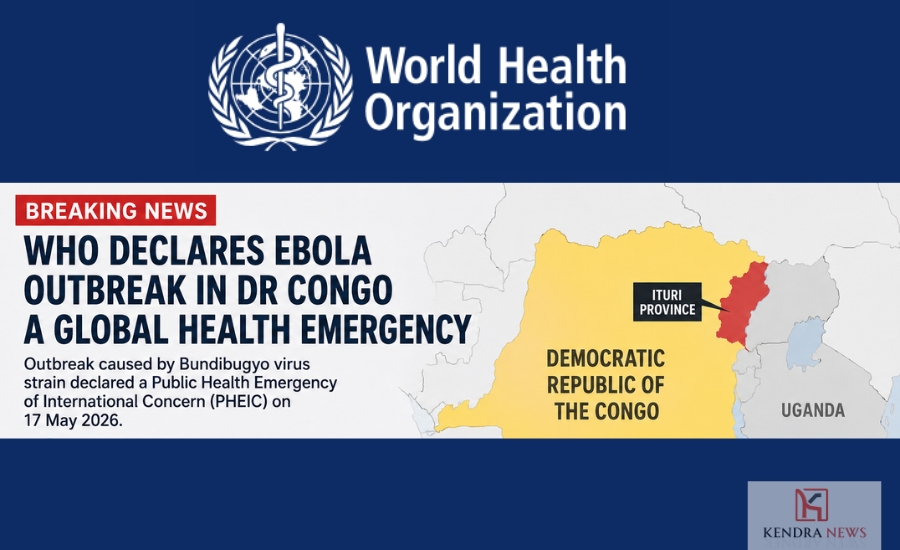
The Democratic Republic of the Congo is battling a major outbreak of Ebola disease caused by the rare Bundibugyo virus strain, prompting the World Health Organization to declare the situation a Public Health Emergency of International Concern (PHEIC). WHO Emergency Declaration
The outbreak was officially declared on 15 May 2026 in the north-eastern Ituri Province and marks the country’s 17th Ebola outbreak since the virus was first identified in 1976. Health authorities say the outbreak is spreading in a highly complex environment marked by armed conflict, population displacement, mining-related mobility, and frequent cross-border movement with neighbouring Uganda. WHO Disease Outbreak News Report
According to the WHO, as of 16 May 2026, at least eight laboratory-confirmed cases, 246 suspected cases and 80 suspected deaths had been reported in Ituri Province. The outbreak has affected the Rwampara, Mongbwalu and Bunia health zones, with additional investigations underway in nearby regions. WHO Situation Update
No Approved Vaccine or Treatment
Unlike the more common Ebola virus strain, there is currently no licensed vaccine or approved therapeutic treatment specifically for Bundibugyo virus disease, significantly complicating containment efforts. Gavi Vaccine Alliance Analysis
The World Health Organization and international research partners are accelerating efforts to identify candidate vaccines and investigational therapies for emergency trials. Current response measures rely heavily on supportive care, rapid case detection, infection prevention measures, contact tracing, safe burial practices and community engagement. Médecins Sans Frontières Briefing
Médecins Sans Frontières stated that existing Ebola vaccines such as Ervebo are only approved for the Zaire Ebola strain and are not currently licensed for Bundibugyo virus. MSF Ebola Response Analysis
Emergency Response Intensifies
Authorities in both the Democratic Republic of the Congo and Uganda have activated emergency coordination systems, strengthened surveillance operations and deployed rapid response teams. The WHO and international partners are supporting laboratory testing, medical supply delivery and infection prevention training. WHO Emergency Operations Update
Dedicated surveillance units are being established in affected and high-risk health zones to improve detection of suspected cases and unexplained deaths. Contact tracing operations are also being expanded in border regions to prevent further spread. WHO Surveillance Measures
Healthcare facilities are under increasing pressure following reports of suspected healthcare-associated transmission and infections among frontline workers. Authorities are reinforcing infection prevention and control measures, including triage systems, personal protective equipment distribution and specialised training for health workers. CDC Health Advisory
Uganda Confirms Additional Cases
In neighbouring Uganda, health officials confirmed additional Ebola infections linked to cross-border transmission from DR Congo. Uganda’s Health Ministry said the latest confirmed cases include a driver and a healthcare worker who had contact with an infected patient. Reuters Uganda Ebola Update
The WHO has warned that high population mobility, insecurity and delayed detection are increasing the risk of wider regional spread across Central and East Africa. Al Jazeera Global Health Emergency Report
Violence and Misinformation Hampering Response
Aid agencies report that mistrust, fear and insecurity are severely complicating outbreak control efforts. In recent days, treatment centres in eastern Congo were attacked and burned by angry residents protesting burial procedures and containment measures. Several suspected patients reportedly fled during the incidents. Associated Press Report
The International Federation of Red Cross and Red Crescent Societies confirmed the deaths of three volunteers involved in humanitarian activities in the outbreak area. Officials stressed that Ebola-infected bodies remain highly infectious, making safe burial practices essential. Reuters Red Cross Report
WHO Advises Against Border Closures
Despite the growing outbreak, the World Health Organization has advised against international travel or trade restrictions, stating that border closures are not supported by scientific evidence and may instead drive movements through informal crossings that are harder to monitor. WHO Travel and Trade Guidance
Preparedness activities are now underway across the region, including strengthening cold-chain systems, identifying clinical trial sites, improving laboratory capacity and training healthcare workers for potential vaccine and therapeutic trials if investigational countermeasures become available. WHO Preparedness Activities
Source: WHO /Media