Why Do Undeclared Allergens Keep Appearing Despite Australia’s Strict Food Safety Regulations?
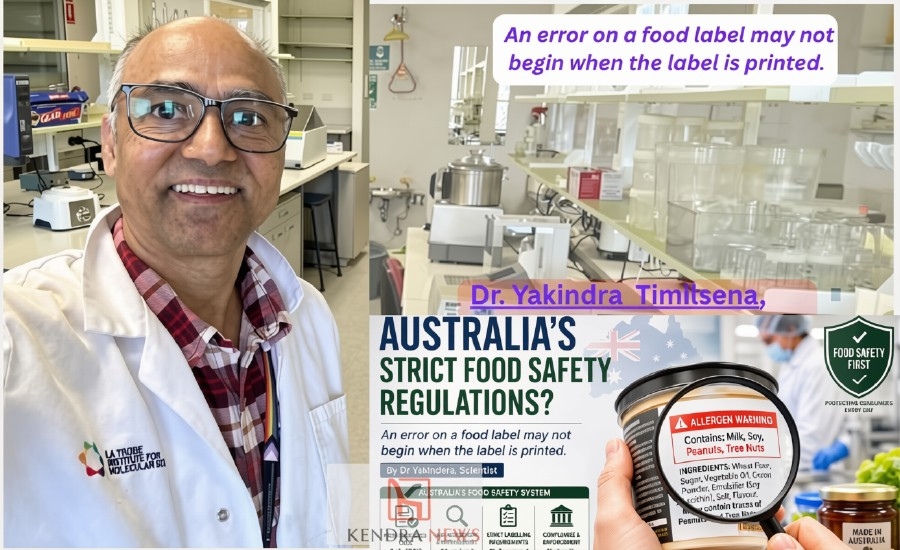
An error on a food label may not begin when the label is printed.
A Short Conversation with Dr. Yakindra (Who is he ? Check here)
Our Student Journalists from the University of Melbourne recently had a short conversation with Dr. Yakindra Prasad Timilsena, a food research scientist and expert in food science and safety.
It can start much earlier when a supplier changes a formulation but fails to inform the manufacturer, a worker packs a product in the wrong packaging, or accidental cross-contamination occurs during production.
When the products are put on the supermarket shelves, the packaging looks beautiful and the label is clear and easy to read, but the information on it may no longer be accurate.
This may appear to be a simple labelling error, but for people with severe food allergies, the consequences can be very different.
Data from Food Standards Australia New Zealand (FSANZ) shows that 92 food recalls occurred in Australia in 2025, higher than the average of 87 cases per year over the past ten years. Among them, 35 cases, accounting for approximately 38% of the total recalls, were related to undeclared allergens, which remained the leading cause of food recalls in Australia.
FSANZ:2025 Food Recall Statistics Released
This was not unique to 2025. From 2021 to 2025, Australia recorded 197 food recalls due to undeclared allergens, 38 in 2021, 29 in 2022, 41 in 2023, 54 in 2024 and 35 in 2025.
FSANZ:Australian Food Recall Statistics
If Australia already has established food safety standards, inspection systems and a national food recall system, why does the same problem continue to occur?
Food sold in Australia is regulated under the Australia New Zealand Food Standards Code. FSANZ develops and manages food standards and coordinates food recalls. In Australia, the Code is primarily enforced by state and territory government agencies and local councils.
Dr Yakindra said, “Actually, Australia operates under a robust regulatory framework.” However, “the supplier changes the formulation and then they do not communicate to the individual or the industries, and that also causes problems.”
The regulatory system can identify food safety problems and recall unsafe products from the market, but it is difficult to guarantee that mistakes will never happen at every stage of supply, production, packaging and labelling.
How Errors Travel Through the Supply Chain
Dr Yakindra said, a lack of staff training and insufficient knowledge of food safety requirements can contribute to the problem. Labelling errors can also occur when a supplier changes a formulation but does not communicate the change to the manufacturer or other businesses. Another thing is about packaging errors, they may use the wrong package.
FSANZ’s analysis of recalls between 2021 and 2025 shows that these risks are not hypothetical. FSANZ also identifies ingredient changes by a supplier that are not communicated as a type of supplier verification issue.
FSANZ:Undeclared Allergen Recall Root Causes
This means that an undeclared allergen does not necessarily result from a complex system failure.
A product packed in the wrong packaging, a formulation change that is not communicated, a label that is not updated, or information that fails to reach the next business in the supply chain, can all cause an error to travel further towards the consumer.
PEAL Makes Labels Clearer, But Accuracy Still Depends on the Supply Chain
In recent years, Australia has tied to address one of the most immediate issues that consumers face, whether food allergen information is clear and easy to understand.
Since 25 February 2024, the new Plain English Allergen Labelling (PEAL) was introduced and food businesses have to comply with requirements. Food that was packaged and labelled before that date in accordance with the previous requirements could continue to be sold until 25 February 2026.
FSANZ:Allergen Labelling for Consumers
The new requirements are intended to make food allergen information clearer and easier to find.
Under PEAL, certain allergens must be declared using specified plain English names and highlighted in bold in the statement of ingredients. A separate allergen summary statement beginning with “Contains” is also required.
For example, milk must be declared using the required name “milk”, rather than leaving consumers to interpret technical terms such as “casein” or “whey”. The allergen summary statement must also clearly identify the allergen, for example, “Contains milk”.
FSANZ:Plain English Allergen Labelling
Dr Yakindra said, “If it is used in Plain English and without any jargon, then definitely the communication will be better.”
However, a clearer label that is easier to understand still depends on accurate information being written on it. A clearer labelling format cannot automatically correct the underlying error in other processes.
A Multicultural Food Market Makes Regulation More Complex
Australia’s multicultural food market presents several challenges, including imported food labelling, online food sales, and cultural and language barriers.
When it comes to Nepalese food, Dr Yakindra mentioned mustard oil, sesame seeds and foods made with wheat flour.
These ingredients are commonly used in Nepalese food to enhance the flavor. However, they may cause allergic reactions in people who are not accustomed to these ingredients.
The problems faced by import enterprises are not only about the amount of resources.
Dr Yakindra said,imported products are manufactured overseas, which can create additional challenges around product quality, labelling, packaging and label information.
Imported food sold in Australia must also comply with local food safety and labelling standards. The Department of Agriculture, Fisheries and Forestry (DAFF) is responsible for the relevant border controls on imported food.
How to import food into Australia – a step-by-step guide – DAFF (agriculture.gov.au)
If mistakes in ingredient, packaging or labelling information happened at the overseas production stage, these problems may continue through the supply chain and enter the Australian market. Even if the final product appears to be fully packaged, the information on the label may not reflect all changes that occurred during overseas production.
This makes a more complex issue for Australia’s multicultural food market, when food crosses countries, languages and different food cultures, can ingredient information be communicated completely and accurately to the final consumer?
Online Shopping Changes the Food Safety Landscape
Changes in the way food is sold are also changing how consumers access food labelling information. In supermarkets, consumers can pick up a product, turn it over and check the ingredients list and allergen declaration. But an increasing number of purchases are now made through phones and computer screens.
A 2025 FSANZ consumer survey found that 58% of Australian and New Zealand respondents had used at least one type of online platform to order food or drinks in the previous 30 days. Among Australian respondents, the proportion reached 62.9%. When shopping for food online, 34.9% of respondents looked for the ingredients list.
At the same time, 26.1% of respondents said that finding relevant nutrition and labelling information online was “somewhat difficult” or “very difficult”.
FSANZ also found that among those who had difficulty finding information online, 52.1% cited inconsistent availability of information, 48.7% cited poor legibility, and around 24% mentioned mismatched product information.
FSANZ: Online Shopping and Labelling – 2025 Key Insights
Dr Yakindra said,online food sales deserve particular attention because consumers may receive food directly from sellers.
When food is purchased online, it may be delivered directly from the seller to the consumer, which may mean there is less third-party oversight along the way. Consumers therefore need to be particularly cautious when buying food online.
Prevention Has to Start Before the Recall
Australia’s food safety system can identify risks after a problem has occurred, coordinate recalls and remove potentially unsafe food from distribution and sale.
But the crucial point is to avoid the problem before it occurs.
Dr Yakindra said, “the inspection is the last stage.”
He said regulatory authorities can sometimes be under-resourced, which may limit how frequently inspections can be carried out. Therefore, awareness and food safety knowledge within businesses are essential, especially among food handlers who need to understand physical, chemical, microbiological and allergen-related risks, as well as how cross-contamination can occur.
One of the key points is staff training.
Dr Yakindra believes that every food worker should be aware of the basic food safety risks, including physical, chemical, microbial and allergen risks, and should understand how cross-contamination occurs and how to minimise such issues.
The importance of this training is also reflected in the corrective measures taken after food recalls.
FSANZ data shows that, among food businesses that conducted recalls between 2021 and 2025, staff training was the most commonly reported corrective action, accounting for 18%. Amended handling procedures and correcting product labels each accounted for 13%.
At the same time, 78% of food businesses reported undertaking more than one corrective action.
FSANZ:Australian Food Recall Statistics
Once a product enters the recall process, fixing the problem may involve more than changing a label. It can also extend to staff training and the food-handling procedures and so on.
Prevention should also extend upstream of the supply chain.
Dr Yakindra believes that food enterprises should establish verified supplier lists and confirm that suppliers meet relevant food safety requirements. In some cases, enterprises can also conduct audits of suppliers to understand whether their food safety procedures are implemented. If suppliers change the ingredients or raw materials, they also need to promptly communicate these changes to enterprises.
For the enterprise itself, he believes that it should establish appropriate food safety plans and procedures, continuously monitor the implementation of these measures, and take timely action when deviations are detected.
Therefore, reducing undeclared allergens cannot solely rely on inspections and recalls after the products enter the market. Whether employees understand the risks, whether supplier information is accurately conveyed, and whether the enterprise can detect and correct deviations during daily production all determine whether the problem can be prevented before the products reach consumers.
Sometimes Consumers Find the Problem First
There is a notable detail in the data of FSANZ. Among the 197 undeclared allergen recalls from 2021 to 2025, 91 problems were initially discovered through consumer complaints.
In contrast, 28 were identified through routine testing by the company, 25 through routine government testing, and 10 through complaints from distributors or retailers.
Consumer complaints were the most common method for identifying problems over these five years.
FSANZ:Australian Food Recall Statistics
This also indicates that consumers are not merely the last ones protected in the entire food safety system. Sometimes, they are also the ones who detect the risks.
For those with food allergies, Dr Yakindra suggests, consumers should read food labels carefully, understand the ingredients and composition of a product, ask questions when they are unsure, and avoid consuming food if they cannot confirm what it contains.
For food enterprises, he believes that businesses should follow regulatory guidelines, maintain proper food safety plans and procedures, monitor whether those procedures are being implemented, and take corrective action when problems are identified.
More importantly, the responsibility for food safety does not only belong to the enterprises.
Dr Yakindra said that manufacturers, retailers, distributors, wholesalers, and consumers all have a role to play in maintaining food safety.
Australia already has strict food standards and has made food labels clearer through the PEAL program.
But what truly determines whether a food can reach consumers safely is whether each link in the supply chain has accurately completed its own tasks.
Dr Yakindra said, “Food safety is everyone’s business.”