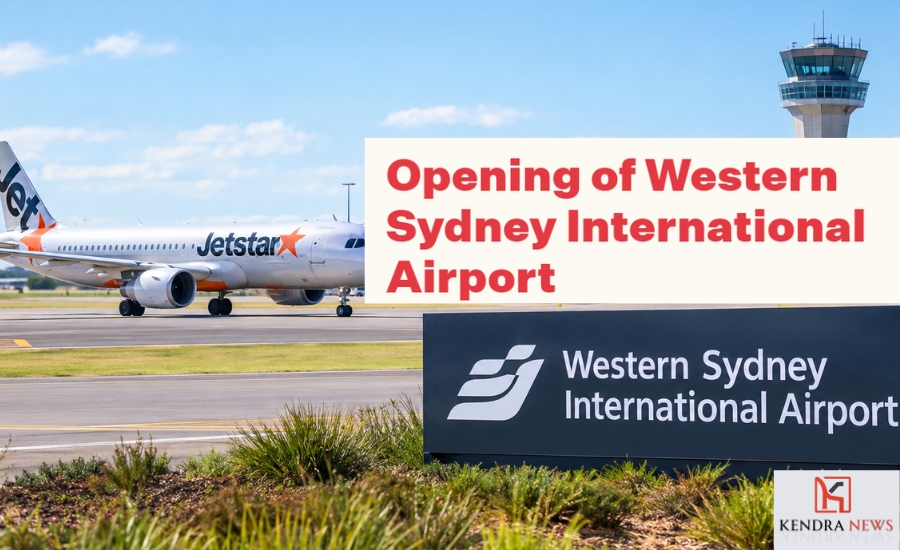
Western Sydney International Airport Opens, Marking a New Chapter for Australian Aviation

Australia’s first new major airport in more than five decades is set to strengthen international connectivity, expand air cargo capacity and create new economic opportunities across Western Sydney.
SYDNEY, Australia — Western Sydney International Airport has officially opened, marking a major milestone in Australia’s aviation infrastructure and a new phase of development for one of the country’s fastest-growing urban regions.
Australian Prime Minister Anthony Albanese declared the airport open, describing it as a major national infrastructure project that would improve domestic and international connectivity while supporting economic growth, investment and employment. The opening marks the culmination of decades of planning and development. The airport has received $5.3 billion in government investment, according to the Prime Minister’s address.
“This is not Sydney’s second airport. This is not even Western Sydney’s new airport. This is Australia’s best airport, without question,” Albanese said during the opening ceremony.
First Flights Mark the Start of Operations
The airport’s first passenger service was scheduled to be a Jetstar flight to the Gold Coast, followed by an Air New Zealand service to Auckland the next day, according to the Prime Minister’s speech. Other airlines expected to operate services include Qantas, Singapore Airlines, Qatar Airways, Vietjet Air and Fiji Airways. Singapore Airlines was scheduled to commence daily services to Singapore, while Qatar Airways planned to introduce flights to Doha three times a week from mid-December, subject to the arrangements outlined in the address.
The airport is designed to accommodate a wide range of commercial aircraft, including the Airbus A380. Its 3.7-kilometre runway is intended to support future growth in passenger and freight operations.
Boost for Trade and International Connectivity
Beyond passenger travel, the airport is expected to strengthen Australia’s air freight network.
According to Albanese, Western Sydney International will increase Sydney’s air cargo capacity by approximately one-third and is ultimately designed to handle around 1.8 million tonnes of cargo annually. The additional capacity could support businesses involved in international trade, logistics and supply chains, while providing greater opportunities for airlines and freight operators.
The airport is also intended to increase competition within Sydney’s aviation market. The Prime Minister highlighted the decision to retain the airport in public ownership as an important factor in encouraging competition between airport operators.
Economic Opportunities for Western Sydney
Western Sydney, home to approximately 2.8 million people according to the address, is expected to be a major beneficiary of the project.
The airport forms part of a broader regional development vision that includes transport infrastructure, logistics facilities, education and commercial investment. Albanese said the airport, together with Western Sydney University and other infrastructure projects, could help attract international investment and support employment, innovation and research.
Construction of the airport had supported 13,243 direct job-years by the end of the previous month, according to figures cited in the speech. The project involved approximately nine million work hours, with more than 2,000 workers employed at its peak. Road and rail connections, including Sydney Metro and planning for a Southwest Sydney rail extension, are also expected to play an important role in connecting the airport with surrounding communities and employment centres.
Sustainability and Australian-Made Materials
The airport incorporates several environmental and construction features highlighted during the opening ceremony.
Approximately 9,000 solar panels have been installed, with the capacity to meet around 40 per cent of the terminal’s energy demand. The runway base also incorporates 5.5 million tonnes of sandstone diverted from landfill from Sydney tunnelling projects, according to the Prime Minister’s address.
The development used Australian materials, including sandstone sourced from the Central Coast and steel products fabricated in Adelaide, Whyalla, Tamworth and Orange. Its design also incorporates First Nations references and material from the Nepean River. The terminal includes 40 check-in kiosks and 34 baggage-drop facilities, alongside modern airport technology designed to support passenger processing.
A Long-Term Transformation for Sydney
The airport’s development reflects decades of political, public-sector and community involvement. Albanese traced the project’s history to earlier proposals for a second Sydney airport, including a 1985 announcement outlining possible locations and layouts. He acknowledged contributions from successive federal and state governments, public servants, industry representatives and community advocates.
The opening also signals a broader shift in Sydney’s economic geography, with the potential to bring more investment and employment opportunities to centres such as Liverpool, Parramatta, Penrith, Campbelltown, Fairfield and Blacktown. For Australia, Western Sydney International represents more than a new transport facility. Its long-term significance will depend on airline growth, passenger demand, freight activity, transport connections and the development of surrounding business precincts.
As operations begin, the airport is positioned to become an important part of Australia’s international aviation network and a major driver of Western Sydney’s future development.
Source: Australian Prime Minister/ Media
Most read
 Card Payment Surcharges to End Across Australia from 1 October
 NDIS watchdog closes only one in three complaints on time as backlog nears 13,000
 ANFS to Host Dashain Celebration in Canberra, Bringing Nepali Culture and Community Together
 2026 ACT Multicultural Awards recognise community leaders and organisations
 Four More Bodies Recovered from Himlung Avalanche in Nepal