Kathmandu Demolishes Riverside Settlements, Exposing Informal Rent Networks and Leaving Thousands in Limbo
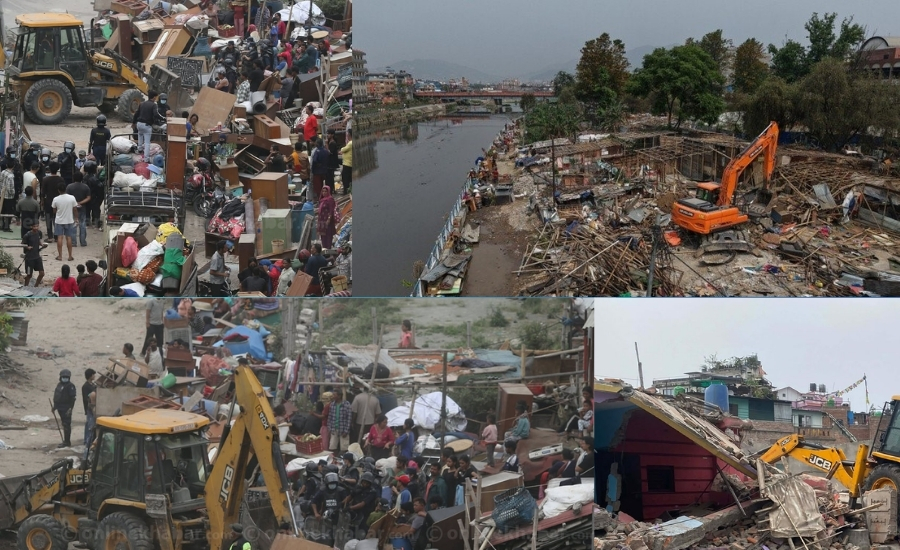
Kathmandu, Nepal — Authorities in Nepal’s capital have begun a large-scale demolition of informal settlements along the banks of the Bagmati River, displacing long-term residents and revealing a shadow system of rent collection within communities widely perceived as “landless.”
Bulldozers moved into the Thapathali riverside area early Saturday after the government issued a two-day notice ordering residents to vacate. Similar clearance operations are underway in Sinamangal, Manohara, and other riverbank settlements, where families have lived for years, in some cases decades.
Officials say the operation is part of a broader effort to reclaim public land and restore environmentally sensitive river corridors. The government has designated three relocation sites for those identified as eligible for resettlement, though details on infrastructure, services, and timelines remain unclear.
For many residents, the sudden eviction has created uncertainty and distress. While some families have arranged alternative accommodation, others are unsure where they will go next. “We’ve been told to leave, but we don’t know where to rebuild our lives,” said one resident packing belongings as demolition crews advanced.
As structures are dismantled, testimonies from residents are shedding light on an informal rental economy operating within the settlements. Several occupants reported paying monthly rent to local intermediaries despite living on public land.
Mukesh Paswan, originally from Sarlahi district, said he paid around 4,000 Nepalese rupees (approximately USD 30) per month for his shelter in Thapathali. “There was a man everyone called ‘mayor’ who collected money. If we didn’t pay, we were threatened with eviction,” he said, alleging that the individual has since disappeared.
In Shantinagar, another riverside area affected by the clearance drive, Sunil Thakur reported paying roughly 8,000 rupees monthly for a makeshift structure where he also operated a small shop. He has since removed his goods in anticipation of demolition.
These accounts suggest that some settlements functioned not only as informal housing clusters but also as revenue-generating systems controlled by local power brokers—raising questions about governance gaps and exploitation within vulnerable communities.
The Bagmati River, considered sacred in Hindu tradition and central to Kathmandu’s ecology, has long suffered from pollution and encroachment. Successive governments have pledged to clean and restore the नदी corridor, but enforcement has been inconsistent.
Urban planners argue that clearing illegal structures is necessary for environmental restoration and flood risk reduction. However, rights groups warn that forced evictions without adequate rehabilitation violate international human rights standards.
“This is not just about removing structures; it’s about people’s lives,” said a Kathmandu-based housing rights advocate. “Without secure alternatives, these families risk falling deeper into poverty.”
Authorities have indicated that demolition will continue in phases across other encroached areas. Meanwhile, the exposure of informal rent systems may trigger further investigations into local-level corruption and exploitation.
For now, the focus remains on immediate humanitarian concerns—ensuring displaced residents have access to shelter, basic services, and a path toward stable housing.
As bulldozers move from one settlement to another, the situation underscores a broader challenge faced by rapidly urbanizing cities worldwide: how to balance environmental restoration, legal land use, and the rights of marginalized urban populations.
: Kendra Bhag