Australia’s population grows by 392,700 as migration remains above government target
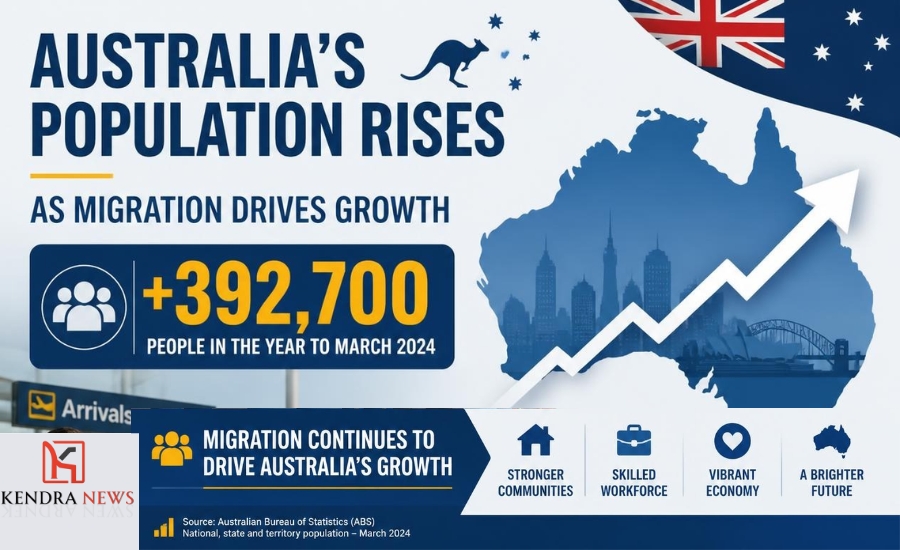
Australia’s population increased by 392,700 people in the year to March 2026, with net overseas migration accounting for almost three-quarters of the growth, according to new Australian Bureau of Statistics (ABS) data. The ABS said Australia’s population reached 27,921,150 people at 31 March 2026, representing annual growth of 1.4 per cent. Net overseas migration contributed 292,100 people, while natural increase — births minus deaths — added 100,600 people.
The figures were released as the federal government moves to reduce net overseas migration to 225,000 in 2027–28, as forecast in the 2026–27 Federal Budget. The Budget also forecasts net overseas migration of 245,000 in 2026–27. The March 2026 figure of 292,100 is 67,100 higher than the 2027–28 forecast. Reaching 225,000 would therefore require a reduction of about 23 per cent from the March 2026 annual level. Home Affairs Minister Tony Burke said the government was confident its migration measures would help achieve the 225,000 forecast. Speaking to the ABC on 17 September, Mr Burke said government projections were already tracking towards the target.
Victoria records strong population growth
Victoria recorded the second-highest population growth rate among the states and territories, with its population increasing by 109,500 people, or 1.6 per cent, over the year. Western Australia recorded the fastest growth, at 2.1 per cent. In Victoria, net overseas migration contributed 81,732 people, while natural increase added 27,677 and net interstate migration contributed 82 people. This means net overseas migration accounted for about 75 per cent of Victoria’s total population growth. The ABS said net overseas migration was the major contributor to population change in every state and territory during the year ending March 2026.
Government announces further migration changes
The latest population figures come as the federal government announces further changes to temporary migration settings. Under the measures announced by Mr Burke, most new international students and graduate visa holders will no longer be able to bring family members as secondary applicants. Families already in Australia will not be separated under the change. Exemptions will apply to some groups, including people from Pacific and ASEAN countries and students undertaking certain courses, including PhD programs. The government will also change the Working Holiday Maker program by introducing a ballot system for second- and third-year visas where a regional work requirement applies. The government says the changes are intended to manage growth in the program and support regional Australia. Other measures include stronger compliance action against people who remain in Australia without valid visas, changes to visitor visa conditions and measures targeting migration agents who submit applications without merit. The government has not provided a precise estimate of how much each individual measure will contribute to reducing net overseas migration to the 225,000 forecast for 2027–28.
Sources
Australian Bureau of Statistics